New Clients:
Get 8 FREE Hours of Professional Home Care

.webp)
Get 8 FREE Hours of Professional Home Care
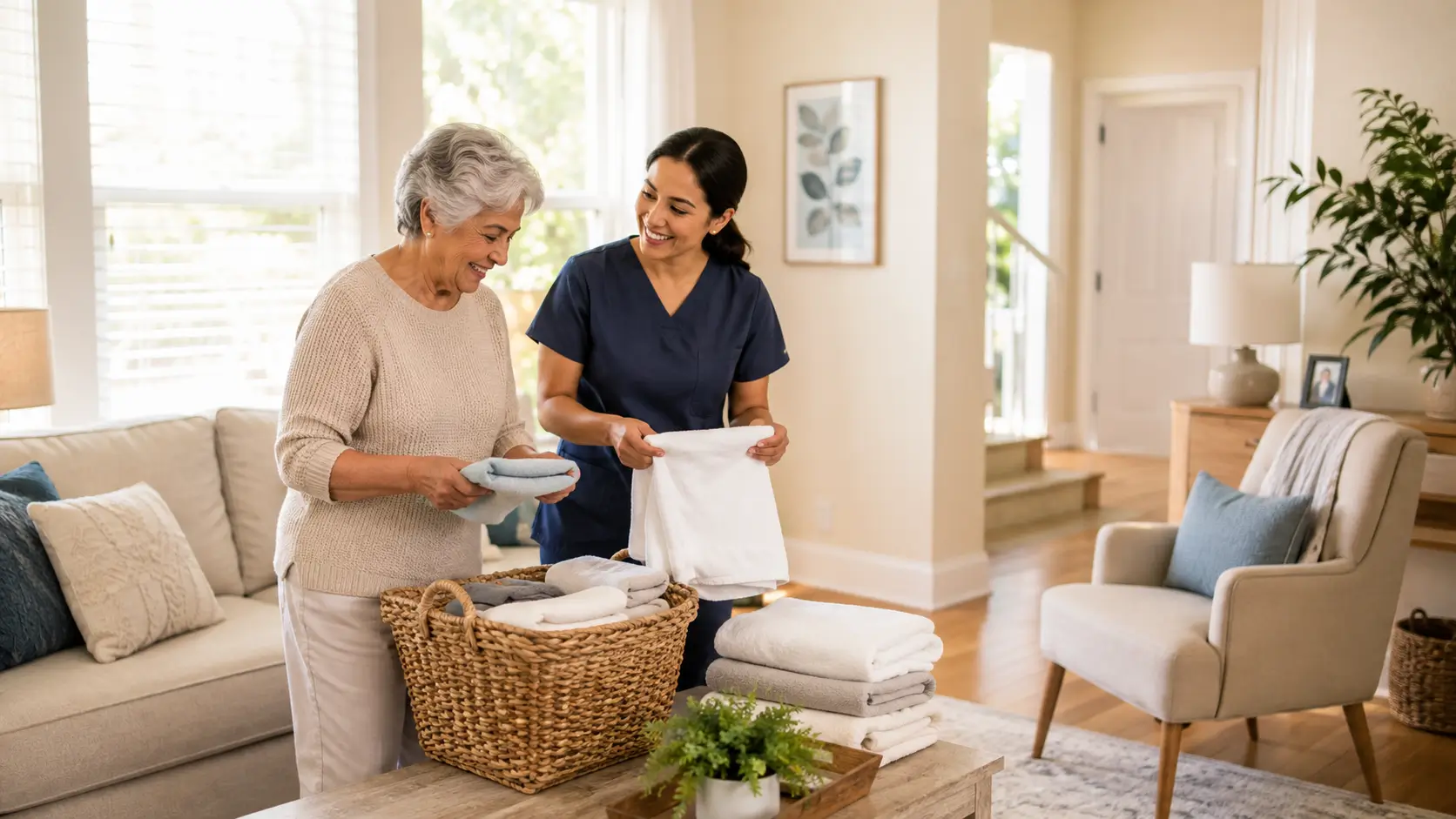
Staying in the home you know, surrounded by your own routines and belongings, is one of the clearest markers of independence as people age. Most families want exactly that for their loved one, and a lot of what protects that independence is genuinely simple: a home that stays clean, organized, and easy to move through safely.
For families across Sacramento, Elk Grove, and Folsom, light housekeeping is often the part of a care plan that gets the least attention, and the one that quietly does the most to keep a loved one confident and steady at home.
The CDC notes that more than one in four older adults experience a fall each year, and fewer than half ever mention it to their doctor. That second detail says the most. People generally do not want a minor stumble to become the reason someone starts questioning their independence, which is exactly why light housekeeping services for seniors focus on preventing that moment altogether, rather than reacting to it after the fact.
Light housekeeping covers the everyday upkeep that keeps a home functional and comfortable: dusting, vacuuming, kitchen and bathroom cleaning, laundry, and general tidying. On paper, that sounds purely practical. In practice, it is one of the most direct ways to support someone's ability to keep living exactly where they want to live.
A home that stays clear of clutter, has clean floors, and functions the way it is supposed to is simply easier and safer to move through. That translates directly into more confidence for the person living there, and less quiet worry for the family checking in from a distance.
Clutter and tripping hazards are consistently identified among the factors that make falls more likely, alongside things like vision changes or certain medications. Unlike some of those other factors, a cluttered walkway or a slippery kitchen floor is something a regular housekeeping routine can address directly and right away.
Regular light housekeeping means these small hazards get caught and cleared before they build up unnoticed over weeks. A loose rug pushed flat, a spill wiped up promptly, a clear path from the bedroom to the bathroom, none of these require a major intervention. They just require someone paying steady attention.
This matters more at night than most people realize. A senior getting up in the dark for the bathroom is navigating mostly from memory, not sight, which means a chair moved slightly out of place or a laundry basket left in the hallway becomes far more dangerous than it would be in daylight.
Keeping those pathways genuinely clear, not just tidy-looking, is one of the simplest and most overlooked ways to protect against exactly the kind of fall the CDC describes.
A caregiver who visits regularly for light housekeeping sees more than the state of the kitchen counter. They notice when something in the home has changed since the last visit: a new stack of unopened mail, a medication left out instead of put away, food that has gone untouched in the refrigerator.
None of these observations require a formal assessment to be valuable. They are simply the natural byproduct of someone paying attention to a space consistently, and they often surface small concerns early enough for a family to address them calmly rather than during a crisis.
For many seniors, needing help with household tasks can feel like a loss of independence rather than a way of preserving it. The way that support is delivered matters as much as the support itself.
A caregiver who works within someone's preferences, respecting how they like things organized and involving them in decisions rather than taking over entirely, helps housekeeping feel like a partnership instead of something being done to them. That distinction often determines whether a person welcomes the support or resists it.
Something as small as asking where a person wants their mail sorted, rather than deciding for them, communicates that their input still matters. Over time, that kind of small respect adds up to something bigger: a sense that accepting help has not meant giving up a say in how their own home is run.
Light housekeeping rarely operates in isolation. It often surfaces information that connects directly to other parts of a care plan, especially home safety. A caregiver who notices a stack of boxes narrowing a hallway, or a bathroom mat that has become a slip risk, is flagging exactly the kind of detail a home safety assessment is designed to catch more formally.
Families who combine light housekeeping with a periodic safety review get the benefit of both an ongoing set of eyes and a more structured, whole-home evaluation, without needing to choose one over the other.
Noah's Dove has supported families across Sacramento, Elk Grove, Folsom, Roseville, Citrus Heights, and Rancho Cordova for over 25 years, with a team of trained, vetted caregivers and a Montessori-inspired approach that treats every household differently rather than applying one script to every home.
Our light housekeeping plans are built around each person's actual routines and preferences, and caregivers stay consistent so a senior is not adjusting to a new face every visit while still getting a home that is genuinely easier and safer to live in.
1. Is light housekeeping the same as a professional cleaning service?
Not exactly. A cleaning service focuses purely on the home itself. Our caregivers combine housekeeping with an awareness of the person living there, noticing changes in routine or safety along the way, which a standard cleaning service is not trained to do.
2. How often do caregivers typically come for light housekeeping?
It depends on the household. Some families schedule a couple of visits a week, while others prefer daily support layered with other care. The right frequency usually becomes clear after the first conversation about what actually needs attention.
3. Can light housekeeping be added to an existing care plan?
Yes. It is one of the easiest services to layer onto other support, like companion care or medication assistance, since the same caregiver visit can often cover more than one need at once.
A clean, organized home does more than look nice. It supports someone's ability to keep living independently, safely, and on their own terms.
Schedule a free consultation to talk through what light housekeeping support could look like for your family.